 There are so very many free clay recipes floating around on the web. It seems like most kids craft websites are simply posting the clay dough recipes without trying the clay first. To us that’s kinda like recommending a recipe without ever having tasted it first.
We hope to try more clay recipes in the future but, for now, this is the only one that we have tried for ourselves.
This recipe is for a flour and salt clay that air drys. No baking required!
How To Make The Clay
- Mix 4 cups of flour and 1 cup of iodized salt in a large bowl. (While the original recipe does not suggest doing so, we mixed the salt and flour prior to adding the water to make what we hoped to be a more uniform clay.)
- Add 1 and 3/4 cups of warm water to the flour/salt mixture. (We started mixing with a wooden spoon as it took a while for the mixture to start resembling clay and then started working with our hands to get the ingredients to combine. This amount of water is enough though it may not appear to be correct at first.
- Knead the clay dough. The original recipe suggested kneading for 10 minutes. Ours took a bit longer.
- Have fun making stuff.
Clay Making Tips
We had plenty of clay to play with making only a 1/4 batch. The pictures that accompany this kids craft project were all made with a 1/4 batch of the clay.
After making several clay creations, the dough seemed to be drying around the edges – covering the yet to be used dough helped to prevent this.
If you find you clay becoming a little dry, when you take the next piece to create with, dip a finger or toothpick in water, let most of the water drip back into the water and then take your moist finger and work with the clay. It doesn’t take much water to get it back into shape and the clay will become very sticky if you add too much water at once. (If you do add too much water, let the clay sit in the open to slightly air dry or add some of the unmoistened bit. Or, dip, not scoop, your fingers into some flour and work the fresh flour into the clay.
When kept in a sealed bag, this clay seems to remain quite usable. While I would not recommend keeping it so long, we made this clay over 8 weeks ago and the clay is still moist and workable.
Crafting With Clay
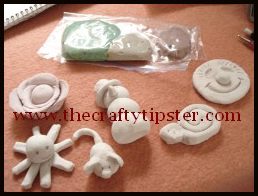 The clay can be colorized with food coloring but it seems to take an extraordinary amount of coloring to get a recognizable color. We tried pink and green. The cabbage rose came out lighter than the wet clay but was definitely pink. Dried sculptures can be colorized with markers. We didn’t try any sort of paints so I can’t say one way or another if they are a good colorizer. The clay soaked up the marker ink like a sponge, so it might pay to try paint on a piece or two before using more expensive marking pens.
To prevent cracking, make firm clay balls and snakes. The head of our octopus was not made firmly and it has cracks across the surface while the other items where we made our shapes more firmly did not.
We found it useful to create a small amount of slip to hold the pieces together while we were creating our sculptures. Slip is simply clay that has an excessive amount of water added to it that has the consistency of thick gravy or kid’s glue.
A toothpick will help make eyes and other details neater. Let the piece sit a few minutes to get better details without creating rough edges.
No Bake Clay
Perhaps the best part of this clay is that it can be left to air dry. It does take a number of days to dry fully and large clay pieces will take longer.
We laid our no bake clay creations on newspaper to dry and it took around a week for some of the larger pieces to dry. Throughout the week, we gently repositioning the pieces on dryer sections of newspaper or in a way that exposed a different side. That sped up the drying process and led to more even drying. Our snowman and cabbage rose took the longest to dry. Both started drying better when we changed what area was resting on the paper.
This no bake clay dries extremely hard. When banged together it sounds like rocks hitting each other. However, it does not dry as hard as rocks and can break if dropped or roughly handled. The extremely pourous nature of the dried clay would seem to take craft glue fairly well.
The clay dries hard enough for sanding.
Negatives of this Clay
- It takes quite a long time to air dry. Do not expect to have fully dried pieces the next day. The original recipe also suggested baking the finished clay pieces at 300 degrees until hard. Unfortunately, the author didn’t share any suggestions on determining when that point was reached.
- Flat edges tend to crack and split but we found making firmer balls and snakes helped this somewhat.
Positives of this Clay
- 100% child safe ingredients.
- No cooking required to make the clay.
- No cooking required to set the clay.
- Dries extremely hard.
- Can be sanded to remove sharp edges and stray bits.
- Finished clay pieces can easily be colorized with markers.
What to Make with Air-dry Clay
The biggest problem our family had after we made this clay was figuring out what to make with it. We had so many ideas while we were mixing the recipe. Ironically, once it was ready to play with, we couldn’t figure out how to turn our ideas into something recognizable.
Too bad we didn’t have these cool books.
The first one is by Bernadette Cuxart. It introduces children to modeling and sculpting. The author uses Fimo clay, but the concepts and tutorials presented might work great with our no bake clay recipe. The book is called Modeling Clay Animals: Easy-to-Follow Projects in Simple Steps
There’s another great book by Bernadette Cuxart that would be great for anyone who hasn’t worked with clay before. It starts with making 3 basic shapes – teardrops, balls and worms. The book is called Modeling Clay with 3 Basic Shapes: Model More than 40 Animals with Teardrops, Balls, and Worms. Again, the author is using pre-colored clay. However, it looks like the projects could be done with no-bake air dry clay and colored with markers or paint after it dries .
Make it in Air-Dry Clay: 20 Creative Projects for Modeling, Sculpting & Crafting is a project book were many of the projects are done using non-colored clay like our recipe does. The book is packed full of great ideas and tips on working with air-dry clay.
Kawaii Polymer Clay Creations: 20 Super-Cute Miniature Projects is exactly what it says; a book full of super-cute projects. Yes, it uses polymer clay, but, many of the little animals that Emily Chen shares would be perfect for any clay including our air dry clay.
p.s. The previews of these books offer lots of great inspiration and ideas. You’ll get a good idea if they contain projects you and your family would enjoy or if you might try just winging it like we did.
What next?
This no-bake clay recipe makes a fun clay to use with younger children.
Unfortunately, this recipe won’t work for making smaller things, with finer details. We tried, it crumbled and cracked whenever we tried making more-detailed or smaller pieces.
However, I’ve been reading the glowing reviews of this Ultra-light Plasticine and Modeling Clay Play-set
One reviewer does not believe the clay is actually plasticine. However, other families found it to be a great product that their children really enjoyed working with. Were I currently in the market (oh, all of the lovely little flowers and things we could make) for some more clay, I would certainly consider picking up a package of this stuff.
UPDATE: It’s been six years since we first posted this article. (Doesn’t seem possible.) The air-dry modeling clay we’ve shared is still among the highest rated on Amazon. Parents and grandparents continue to be happy with their purchases. We’re excited to continue recommending such a great product to our readers.

hi im wanting to make a bowl or plate for decorations could i put food coloring in this to add color?
Hi Nikki,
As I said in the tutorial, this clay does take food coloring. Unfortunately, it took quite a bit of colorant to get a strong color. I don’t know how much it would take for a bold Christmas red or green as it took quite a bit of red dye to get the pink clay we made.
The bad thing we found is that with time, the pieces we colored with food coloring faded. I’m not sure how long we had them before they were killed by one of our cats, but the pink pieces had lost a great deal of their color – it might have been a year or two so if you are making this for one-time-use, it might not matter as much.
Where we had marked the pieces with a marker, the colors remained true. I would recommend painting or using markers on dried pieces rather than using food coloring. This clay is so touchy about the amount of moisture that even a few drops of food coloring would make it sticky. Do read the label of any paint you use if you plan on putting food in your bowl. I would hate for you to to take something that is safe and turn it into something dangerous.
Good luck and thank you for taking the time to comment.
Regards,
Michele
tried this project with our AFTER SCHOOL PROGRAM – was a GREAT SUCCESS 🙂 the only thing we did differently is add 1/4 cup (mixed color) glitter to the Dough 🙂 worked wonderfully – and even when the children colored them with Crayola Markers – the glitter showed through – was very nice – we have b/t 45-60 students and 2 1/2 batches of the ^ recipe made enough dough for each child to make an ornament – and then some 🙂
Thanks for the great recipe I will use it again and again 🙂 it stores well in a frosting container and lid – for reuse 🙂
I made this recipie with our ENCORE (after-school) Program 🙂 it worked wonderfully – the only thing we did was ADD Mulit-Colored Glitter to the Dough (about 1/3 to 1/4C Total) and it was awesome – even when the kids colored the dough with crayola markers 🙂 the sparkel shined through and gave it a sparkel too 🙂 was fun – the kidos loved this project 🙂 and we’ll definately use it again 🙂
Glitter dough. What a great idea! Love it. How cool that it didn’t take the marker colors. Bet it was a hit with the kids. Thanks for letting me know it went so well and the great idea of adding in glitter.
can it hold water? I need to make a dam for school with actuall water and I need something like clay that won’t go soft with water. anything? please?
I’m terribly sorry for not replying sooner. Your comment was buried amongst hundreds of spam messages. Unfortunately, I don’t know about if the clay can hold water or not. I would suspect since it was air dried that it might hold water for a little while but it would probably melt in time.
AWESOME!!!my kids had soooo much fun with this and the oldest made her science project out of the extra!!!
My Sunday School lesson for this week in is teaching the 10 Commandments (ages 6 to 11). I had the bright idea to allow the children to make little tablets of stone using clay. I wanted to find a recipe that would allow the clay to air-dry. I plan to let the children use tooth picks to write on the tablets. The following week maybe we can use a permanent marker to fill in the writings made with the tooth picks.
I’m resisting the desire to add glitter to the clay 🙂
Thank you for the post!
I used this for a christmas ornament thing with my husband. He loves modeling, and all things clay. I made this, and he asked, “How did you make this?” I replied, “Flour, salt, water.” He looked amazed, and then we made some ornaments for our christmas tree in memory of our daughter, who passed away at 18. We will remember her forever with these awesome ornaments!
Oh Ivy, thank you so much for sharing your story. I always love hearing when someone enjoys one of my projects. But, I’m honored that you created something so meaningful with it. Merry Christmas!
I think it would make sense that if you can use enough food coloring to keep the color after the clay has dried, then cover it in clear flex seal, the color should not fade because it has nothing in direct contact with the surface of the clay to rub away the coloring. Same with water, the water won’t have contact with the clay so it will not melt. I have not actually tested this theory yet, so I’m not saying it will work for sure, its just an idea i came up with. Feel free to test it yourself.
My pieces where sitting on shelves and not handled all that much. It was like the color evaporated or something. lol The colors applied with markers seemed to not fade at all or maybe just a little.
The sealant might keep the color from fading though. It would be worth trying.
Hey. Thinking of trying this to make Christmas ornaments with a group of little babies I work with. Wondering how long to wait for it to dry before trying to write with a marker on it? And is a sharpie ok to use?
Sorry for the oh-so-late reply.
The time to dry varies a bit from piece to piece. It depends upon how thick the piece is, how solid vs if hollow and if you remember to change the positions a bit. We made a little snowman and left him standing upright. The top was dry but the bottom that had been resting on the newspaper had hardly dried at all.
The dryer, the better as for when to write on them. If the clay is a bit wet, it sorta melts into the marker’s tip making a bit of a mess. Sharpies work great. We had the best luck using them over any of the other markers we tried.
Unless you pre-make the clay forms/ornaments, you will need at least two different sessions with the kids so that the clay will dry. You could test some in the oven. But, I would do it very slowly so the edges don’t crack.
Good luck.
I got a recipe to make Clay out of corn starch, white school glue, lemon juice and baby oil but it didn’t say if I can bake it or if it’s a air dry!?! And if it’s to be baked then at what temperature and how long?? Plz if someone knows can you please get back to me as soon as possible???
Thank you so very much 😄
Sounds like a variation of cold porcelain. It probably requires “cooking” to create the clay but it would most likely be air drying.
Hi I love this recipe!
I’m studying to be a teacher and I need to present 10 art activities to a Reception Year Class, I thought of asking them to model a parent or family memeber from the clay. How much dies this recipe make? I need to make enough for 31 kids, so I’d appreciate if you could advise me on how much I should increse this recipe by, if need be.
Thank you
Meagan
Hi Meagan,
I cringe every time I get a comment like yours. I always fear that my answer will lead to disaster. I know it’s been almost a week. Hopefully, you came up with my suggestion on your own since then.
We made 1/4 of the recipe. There was plenty for Mom and I to play around with but I’m not sure if we could have made something serious with what we had.
I’m not sure what you mean by “model a parent or family member” but that sounds like something that would be solid and require quite a bit of clay.
My suggestion is to make a test batch at home and see if you can create what you envision the kids making. Then you’ll know how well the idea works plus how much clay you might need for 31 kids. I’m guessing you’ll need, at minimum 1/4 of this recipe per child; depending upon the project, it might be as much as 1 recipe/batch per child.
Also keep in mind, if they make something fairly large and solid, it will take a long time, maybe weeks, to fully dry.
I would also check pricing to make a lot of this clay vs buying a big box of the air dry clay Crayola sells.
Good Luck!
Michele
This was good recipe except for one thing: it was too sticky. So, I had to add a little more flour. My little cousins and I had so much fun with this! We colored it wth food coloring. We played with it for a LONG time.
So fun! Thank you for this recipe!
So glad you enjoyed it. The dough/clay does tend to change consistency very easily. Even a drop or 2 of water could make it more pliable or too sticky.
Is it ok if you put the clay in a container instead of a Ziploc?
Don’t see why not. But, you might want to use a bit of plastic wrap under the lid to ensure it’s truly air tight.
does it dry
It dries rock hard.
Well done with the clay! I had to make 20 batches for my preschool students and they LOVED it. I am happy to say I will use this recipe more often. I have searched the web for a long time and seen many other recipes that don’t satisfy me, but this one is really good. Thanks for helping all the other people that used this recipe. Also, I have a question when it dries does it become a hard material or more of a soft breakable material. I really enjoyed the recipe Thank you!
Hi Aashi! I’m so glad the recipe worked with with your students! The stuff we made was a bit on the thick side and took a few days to fully dry. But, it dried very hard – we could knock most of our pieces on a table and it didn’t crack or flake. Probably depends on how thick your piece is. Also, when I drew on ours, (maybe a week or more later) with a marker, it didn’t get soft from the ink – it sucked it up like an old sponge.